

Choosing the wrong industrial sensor is a special kind of heartbreak. You spend weeks designing a flawless system, only to realize your new sensor requires an external power rail you don't have, or speaks a completely different language than your PLC.
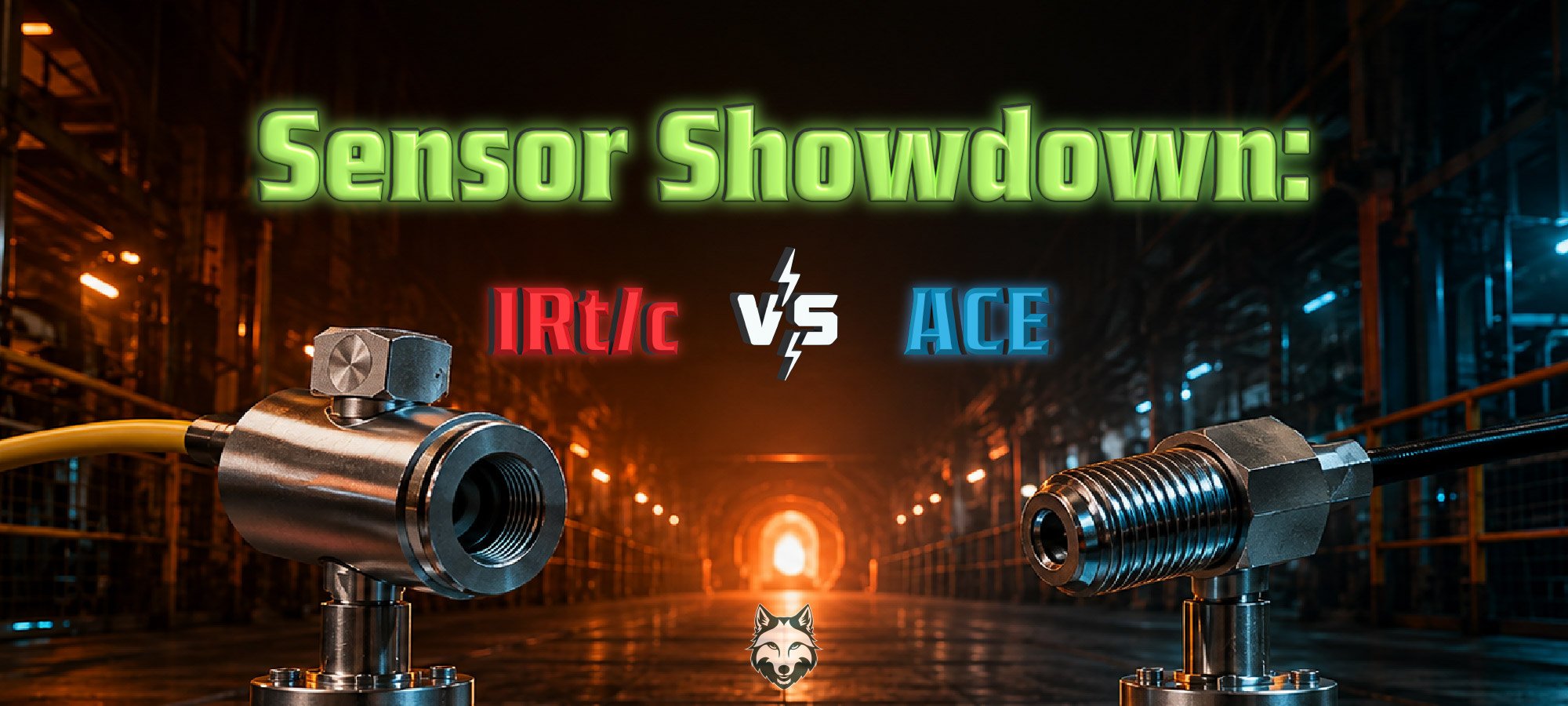
When it comes to non-contact temperature measurement CleverIR (formerly Exergen Global), makes some of the absolute best hardware on the planet. But they also give you a classic engineering dilemma: Should you go with the legendary, self-powered IRt/c (Infrared Thermocouple) Series, or step into the future with the ultra-flexible, software-configurable ACE Series?
Both offer elite accuracy, but they approach your control loop with completely different vibes. Let's break down the sibling rivalry so you don't end up frustrated at your control panel.

Round 1: Power & Wiring (The "Ghost" vs. The "Guzzler")
The most shocking difference? One of these sensors doesn't even need a power cord.
- The IRt/c Series: The CleverIR IRt/c series is essentially a passive math wizard. It's self-powered and makes its own electrical signal. You wire it directly into a standard thermocouple card, and boom, you're reading temperatures. No external power supply needed. It's the ultimate drop-in replacement for an old probe.
- The ACE Series: The CleverIR ACE sensor actually houses its own brain, which means it needs 12–30 VDC to stay awake. What do you get in return for giving up a power terminal? Clean, beautiful, noise-immune linear signals. Say goodbye to expensive, fragile thermocouple extension wires over long distances.
Round 2: Inventory Control (The SKU Diet)
If your spare parts closet looks like a graveyard of highly specific components, pay close attention.
- If you use traditional IRt/c sensors, each unit is factory-calibrated for a rigid temperature curve. If you change machine specs or switches production lines, that sensor can't adapt. You have to order an entirely different part number.
- The ACE Series is a localized cure for SKU bloat. Built on a single physical 18mm platform, the ACE can be digitally reprogrammed on the fly using a simple laptop connection. You can rescale its temperature range or speed up its response times with a few clicks. It's one part number that wears a hundred different hats.
Round 3: Shiny Objects (Managing Emissivity)
Reading the temperature of shiny, reflective surfaces is the bane of every control engineer's existence.
- IRt/c units rely on fixed optics optimized for dull/matte targets. If you throw a shiny metal or reflective plastic in front of it, you’ll have to do some creative programming math in your PLC to fix the offset.
- The ACE sensor handles material existential crises natively. Thanks to software-adjustable emissivity, you can change how the sensor "sees" different materials dynamically via UART commands.
Round 4: Physics & Distance (Sniper vs. Shotgun)
Where are you physically mounting this thing?
- If your target is a tiny piece of hot metal buried deep inside a furnace three feet away, you need a sniper. The IRt/c series offers narrow focal options to pinpoint small zones from a distance.
- If you are cramming a sensor into a tight mechanical bracket right next to a wide, moving conveyor belt, you want the ACE series. It uses ultra-compact wide-angle optics to get an accurate average of close-up surfaces.
The Verdict: Who Wins?
- Stick with the IRt/c if: You love simplicity, hate running power wires, are retrofitting an older panel, or need to aim at a tiny target from across the room.
- Upgrade to the ACE if: You are building new machines, want to talk to your sensors digitally, hate stocking 50 different part numbers, or need to adjust settings on the fly.