---
title: Behind Every Cool Data Center Is a Lot of Water
description: Data centers run hot—and cooling them takes more water than you think. See how smarter automation reduces waste while keeping systems running strong.
image: https://blog.wolfautomation.com/hubfs/The-Water-Powering-the-Digital-World-270.jpg
---
[Skip to content](https://blog.wolfautomation.com/behind-every-cool-data-center-is-a-lot-of-water#main-content)
[Homepage](https://www.wolfautomation.com/)
- [View All Blogs](https://blog.wolfautomation.com/)
- [Shop By Category](https://www.wolfautomation.com/products/)
- [Shop by Brand](https://www.wolfautomation.com/brands)
- [Contact Us](https://www.wolfautomation.com/contact-us/)
- [Blog Archive](https://www.wolfautomation.com/blog/)
- [View All Blogs](https://blog.wolfautomation.com/)
- [Shop By Category](https://www.wolfautomation.com/products/)
- [Shop by Brand](https://www.wolfautomation.com/brands)
- [Contact Us](https://www.wolfautomation.com/contact-us/)
- [Blog Archive](https://www.wolfautomation.com/blog/)

# Behind Every Cool Data Center Is a Lot of Water

Theresa Hoffman
May 4, 2026
Every time you check what your favorite influencer is up to, scroll through your go-to app, or ask AI whether that sketchy spot on your wall is a quick fix or the start of a full-blown renovation… something behind the scenes is working overtime.
Data centers may not always be top of mind, but they’re doing the heavy lifting of our digital lives.
A single large data center can consume as much electricity as 100,000 homes. Modern AI-optimized racks often require 40–60 kW of thermal power—or more—to dissipate the intense heat they generate. To put that into perspective, that’s roughly equivalent to 8–12 homes running air conditioners nonstop. Data centers are built to last up to 20 years, so choosing the right location and cooling strategy is critical. And when it comes to cooling, water and data centers have a very close relationship
**The Hidden Water Cost of Keeping Servers Cool**
**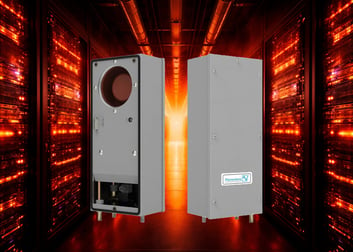**
Cooling is essential because electronics produce a significant amount of heat. In many facilities, entire rooms are dedicated to cooling equipment.
Traditional systems rely on evaporative cooling towers, where water absorbs heat and evaporates to carry it away. That heat is then transferred to a building-level [heat exchanger](https://www.wolfautomation.com/products/thermal-management-solutions/?_bc_fsnf=1&Thermal+Product+Type=Heat+Exchanger%2C+Air%2FWater) in a closed loop. At the facility level, [air conditioning](https://www.wolfautomation.com/products/thermal-management-solutions/?_bc_fsnf=1&Thermal+Product+Type=Air+Conditioner) or fans cool the liquid before rejecting the heat to the outside air—much of which becomes vapor and is released.
In large-scale operations, the numbers add up quickly. Some data centers can use up to 4 million gallons of water per day for cooling. In evaporative systems, significant amounts of water are lost daily to evaporation, often sourced from fresh, potable supplies.
Even everyday digital activity has a footprint. Research suggests that 10–50 AI searches—or a short conversation—can consume the equivalent of one bottle of water, largely due to the energy and cooling required to support those interactions.
**How Liquid Cooling and Automation Reduce Water Use**
****
Liquid cooling is gaining traction because it’s far more efficient than air alone for high-density AI workloads. In a closed-loop system, coolant circulates near the chips to capture heat, then transfers it to a [heat exchanger](https://www.wolfautomation.com/products/thermal-management-solutions/?_bc_fsnf=1&Thermal+Product+Type%5B%5D=Heat+Exchanger%2C+Air%2FWater&Thermal+Product+Type%5B%5D=Heat+Exchanger%2C+Air%2FAir).
This approach not only improves efficiency but can also free up valuable space—sometimes allowing rooms previously filled with bulky air-cooling equipment to be used for additional servers.
The real gains, however, come from smart automation.
Instead of running fans and pumps at full speed all the time, automated systems adjust based on actual heat load, ambient conditions, and demand. This reduces unnecessary evaporation, lowers blowdown (the water discharged to control mineral buildup), and cuts overall water and energy consumption.
**MWA Solutions That Make It Possible**
Variable Frequency Drives (VFDs)
Enable precise control of cooling tower fans and condenser water pumps. By adjusting speed based on demand, [VFDs](https://www.wolfautomation.com/products/vfds/) can reduce energy use by 30–50% while helping stabilize temperatures and minimize water loss.
High-Efficiency AC Motors and Motor Controls
Built for wet, demanding environments, these systems include [starters, contactors, overload relays](https://www.wolfautomation.com/products/contactors-starters-overload-relays/), and protectors for reliable performance.
Sensors and Process Instrumentation
[Level](https://www.wolfautomation.com/products/sensors-specialty/?_bc_fsnf=1&Type+of+Sensor=Level+Measurement), flow, [temperature](https://www.wolfautomation.com/products/temperature-sensors-t-c-rtd-infrared/), and conductivity sensors deliver the accurate, real-time data needed for automated control and early issue detection
Controllers and HMIs
Programmable logic controllers [(PLCs)](https://www.wolfautomation.com/products/plcs-and-smart-relays/) and user-friendly interfaces allow centralized monitoring and system-wide adjustments
**Moving Toward Sustainable Cooling**
Automation isn’t just a nice-to-have—it’s becoming essential as data centers balance rapid AI growth with water scarcity and sustainability goals.
By optimizing cooling towers and supporting liquid cooling systems, operators can improve efficiency, reduce water use, and lower operating costs—all while maintaining reliable performance.
Choosing the right [VFDs](https://www.wolfautomation.com/products/vfds/), [motors](https://www.wolfautomation.com/products/motors/), [sensors](https://www.wolfautomation.com/products/temperature-sensors-t-c-rtd-infrared/), and [controls](https://www.wolfautomation.com/products/plcs-and-smart-relays/) is key to keeping systems running smoothly—and keeping our digital world up and running.
## Share this post
[mailto:https%3A%2F%2Fblog.wolfautomation.com%2Fbehind-every-cool-data-center-is-a-lot-of-water](mailto:https%3A%2F%2Fblog.wolfautomation.com%2Fbehind-every-cool-data-center-is-a-lot-of-water)
## Keep reading
### [ Brand Spotlight The Infrared Sensor Showdown: CleverIR vs IRt/c](https://blog.wolfautomation.com/the-infrared-sensor-showdown-cleverir-vs-irt/c)
### [ Bought a 3-Phase Machine for Your Garage? Here's the Good News](https://blog.wolfautomation.com/bought-a-3-phase-machine-for-your-garage-heres-the-good-news)
[Subscribe to Our Newsletter](https://www.wolfautomation.com/newsletter)
[](https://blog.wolfautomation.com/)
##### *Marshall Wolf Automation is a proudly independent and women-owned industrial controls distributor since 1984!*
**Copyright © 2026 Wolf Automation. All rights reserved.**
```json
{
"@context" : "https://schema.org",
"@type" : "BlogPosting",
"author" : {
"@type" : "Person",
"name" : "Theresa Hoffman",
"url" : "https://blog.wolfautomation.com/author/theresa-hoffman"
},
"dateModified" : "2026-05-04T16:01:22.743Z",
"datePublished" : "2026-05-04T16:01:22.000Z",
"headline" : "Behind Every Cool Data Center Is a Lot of Water",
"image" : [ "https://blog.wolfautomation.com/hubfs/The-Water-Powering-the-Digital-World-270.jpg" ],
"mainEntityOfPage" : {
"@id" : "https://blog.wolfautomation.com/behind-every-cool-data-center-is-a-lot-of-water",
"@type" : "WebPage"
},
"publisher" : {
"@type" : "Organization",
"logo" : {
"@type" : "ImageObject",
"url" : "https://blog.wolfautomation.com/hubfs/logo-master-light-background_RGB.jpg"
},
"name" : "Marshall Wolf Automation"
}
}
```