---
title: What VFDs Have to Do with Data Center Cooling
description: Choosing the right VFD for data center cooling? Learn what to consider for reliable performance, energy efficiency, and temperature control.
image: https://blog.wolfautomation.com/hubfs/Smart%20Drives.%20Cool%20Servers..jpg
---
[Skip to content](https://blog.wolfautomation.com/what-vfds-have-to-do-with-data-center-cooling#main-content)
[Homepage](https://www.wolfautomation.com/)
- [View All Blogs](https://blog.wolfautomation.com/)
- [Shop By Category](https://www.wolfautomation.com/products/)
- [Shop by Brand](https://www.wolfautomation.com/brands)
- [Contact Us](https://www.wolfautomation.com/contact-us/)
- [Blog Archive](https://www.wolfautomation.com/blog/)
- [View All Blogs](https://blog.wolfautomation.com/)
- [Shop By Category](https://www.wolfautomation.com/products/)
- [Shop by Brand](https://www.wolfautomation.com/brands)
- [Contact Us](https://www.wolfautomation.com/contact-us/)
- [Blog Archive](https://www.wolfautomation.com/blog/)
Industry Focus
# What VFDs Have to Do with Data Center Cooling

Theresa Hoffman
October 8, 2026
Love them or hate them, we need data centers to watch our streaming services and keep businesses up and running. And with the growing demand for AI, data centers are working twenty-four-seven.
We’ve already covered [how heat is a big problem in data centers](https://blog.wolfautomation.com/behind-every-cool-data-center-is-a-lot-of-water), so it’s no surprise that more manufacturers are offering solutions to help tackle the issue.
That means cooling systems need to be ready to work whenever they’re needed. Fortunately, variable frequency drives (VFDs) can help.
VFDs give cooling equipment the ability to adjust motor speed based on demand, helping data centers manage temperatures, improve energy efficiency, and reduce unnecessary wear and tear.
But how do you choose the right VFD for the job?
**What Do VFDs Have to Do with Data Center Cooling?**
Before we get into the details, let’s talk about what [VFDs](https://www.wolfautomation.com/products/vfds/) actually do.
A variable frequency drive controls the speed of an [electric motor](https://www.wolfautomation.com/products/motors/) by adjusting the frequency and voltage of the power supplied to it. In simpler terms, it allows equipment to run faster or slower depending on what the application needs.

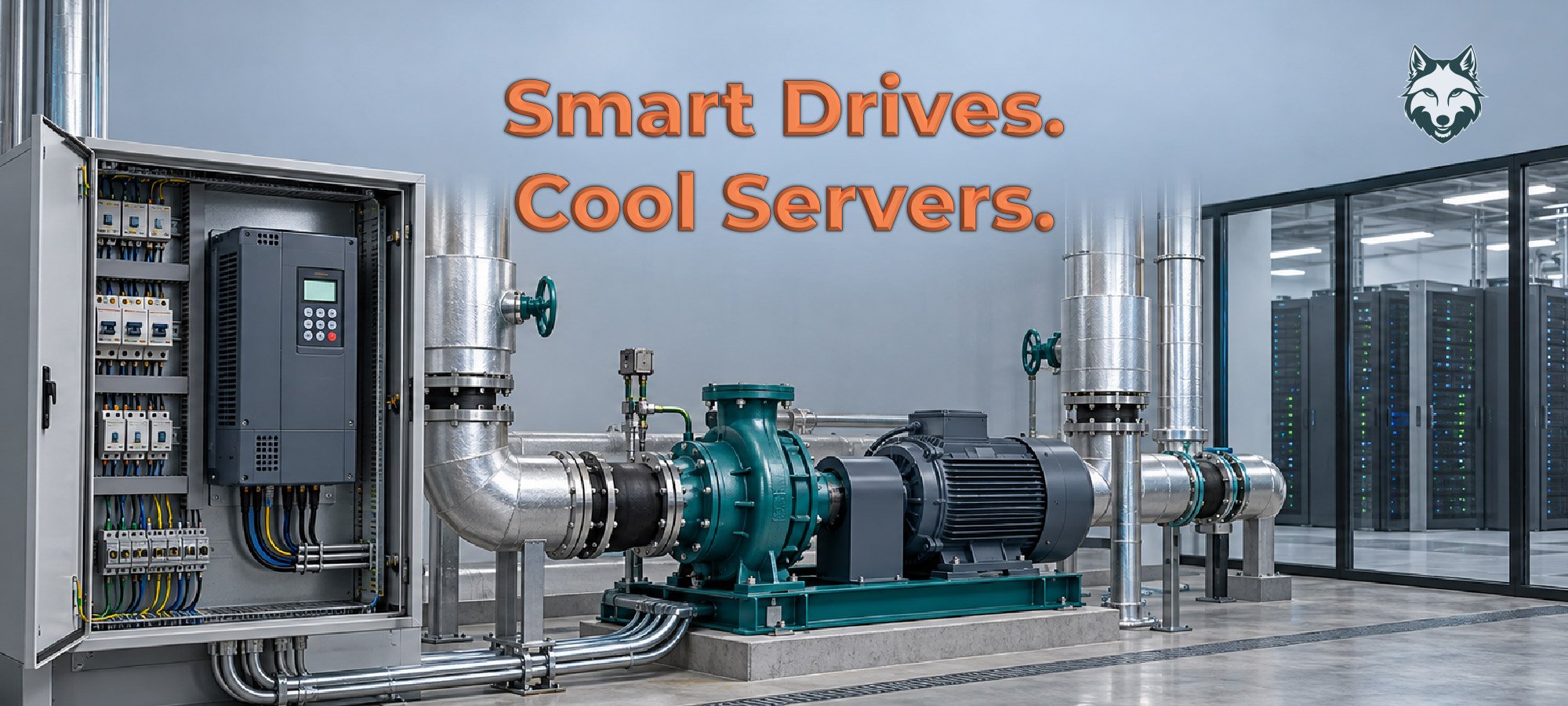
For data centers, that can mean controlling the speed of cooling tower fans, [air-handling units](https://www.wolfautomation.com/products/thermal-management-solutions/), and chilled-water pumps.
Instead of running equipment at full speed all the time, a [VFD](https://www.wolfautomation.com/products/vfds/) can adjust its output as cooling demand changes. When less cooling is needed, the motor can slow down. When temperatures rise and more cooling is required, it can speed back up.
Why does this matter? Running motors at lower speeds can reduce energy consumption, particularly in centrifugal fan and pump applications. It can also help reduce mechanical stress on equipment.
And when a data center is operating around the clock, even small improvements in efficiency can add up.
Of course, not every VFD is the right fit for every application. Here are a few things to consider before selecting one.
1\. Start with the Application
Not all cooling systems are created equal. Before selecting a VFD, it’s important to know what equipment it will be controlling and how that equipment needs to operate.
For example, a data center may use VFDs to control chilled-water pumps, cooling tower fans, air-handling units, and pumps that circulate coolant through [liquid-cooling systems](https://www.wolfautomation.com/products/thermal-management-solutions/).
Each application has different operating requirements. A pump moving chilled water throughout a facility may have different speed and pressure needs than a fan circulating air through a server room.
Understanding how the equipment operates, how much cooling is needed, and how often demand changes will help determine which VFD is best suited for the job.
It can also help prevent a common mistake: selecting equipment based only on how it performs when everything is running at full capacity. After all, cooling systems don't necessarily need to run full speed 24/7.
2\. Don't Just Look at Horsepower
When selecting a [VFD](https://www.wolfautomation.com/products/vfds/), horsepower is a good place to start, but it's not the whole story.
You'll also need to consider the [motor's](https://www.wolfautomation.com/products/motors/) voltage, full-load current, operating speed, and the amount of torque required to get the job done.
Think of it this way: just because two motors have the same horsepower doesn't mean they'll have identical operating requirements. The VFD needs to be [properly matched to the motor](https://blog.wolfautomation.com/shopping-for-a-motor-a-guide-to-picking-the-right-one) and the demands of the application.
It's also important to consider whether the equipment will need to accelerate quickly, operate at very low speeds, or handle changes in load.
And while it may be tempting to size up "just in case," bigger isn't always better. An oversized drive can take up unnecessary panel space and add cost without providing any real benefit.
The goal is to find a VFD that can handle the job today while accounting for any planned changes down the road.
3\. Consider the Environment
Data centers may be known for their carefully controlled environments, but that doesn't mean every piece of equipment gets to enjoy the same comfortable conditions.
VFDs installed in electrical rooms, rooftop cooling equipment, or enclosed pump systems may encounter [higher temperatures](https://www.wolfautomation.com/products/thermal-management-solutions/?_bc_fsnf=1&Thermal+Product+Type=Thermostat), limited ventilation, dust, or moisture.
These conditions matter because VFDs generate heat while operating, and excessive heat can affect their performance and service life.
Before selecting a drive, consider where it will be installed, the surrounding temperature, available ventilation, and the type of [enclosure](https://www.wolfautomation.com/products/enclosures/) required.
It's also important to check whether the drive needs to be derated. In this case, derating means reducing the drive's usable capacity to account for conditions such as high temperatures or installation altitude.
A VFD that looks perfect on paper may need a different rating or installation arrangement to perform as expected in the real world.
4\. Make Sure Your VFD Can Keep Up with Your Controls
A data center's cooling system doesn't operate in isolation. It relies on [sensors](https://www.wolfautomation.com/products/temperature-sensors-t-c-rtd-infrared/), [controllers](https://www.wolfautomation.com/products/temperature-process-controllers/), and [building management systems (BMS)](https://www.wolfautomation.com/products/plcs-and-smart-relays/) to monitor conditions and make adjustments.
VFDs can work alongside these systems to help maintain the temperatures, [pressures](https://www.wolfautomation.com/products/pressure-sensors-and-switches/), and flow rates needed for reliable cooling.
For example, when a sensor detects a change in cooling demand, the control system can tell the [VFD](https://www.wolfautomation.com/products/vfds/) to adjust motor speed accordingly.
Many drives also offer built-in features that can simplify system operation. Depending on the application, these may include PID control, adjustable speed limits, automatic restart functions, and fault monitoring.
Communication is another important consideration. The VFD needs to be able to share information with the facility's control system, whether that's through a supported industrial communication protocol or hardwired signals.
This allows operators to [monitor equipment status](https://www.wolfautomation.com/products/hmi/), review [alarms](https://www.wolfautomation.com/products/buzzers-audible-alarms/), and identify potential problems without having to inspect every drive individually.
The key is to determine what information your system needs and make sure the VFD can provide it.
5\. Don't Forget About Power Quality
Here's something that may not be top of mind when selecting a VFD: power quality.
VFDs are useful tools for controlling motors, but they can also introduce electrical disturbances called harmonics. When multiple drives and other electronic equipment operate within the same facility, those disturbances can add up.
For data centers, where electrical reliability is a major priority, it's important to understand how VFDs will affect the facility's electrical system.
Depending on the application, additional components such as line reactors or harmonic filters may be needed to help manage these effects.
[Motor cable](https://www.wolfautomation.com/products/cable/) length is another factor to consider. Long cables between a VFD and its motor can create additional electrical stress, potentially requiring output [reactors](https://www.wolfautomation.com/products/line-reactors-load-reactors/) or filters to help protect the motor.
The right solution depends on the drive, motor, wiring, and overall electrical system. Planning for these considerations early can help prevent unwanted surprises during installation.
6\. Plan for Reliability and Maintenance
Data centers don't have much room for unexpected downtime. When cooling equipment goes down, the consequences can extend well beyond an uncomfortable room.
That's why reliability should be part of the VFD selection process from the beginning.
Consider what happens if a drive fails. Is there another pump or fan available to keep the cooling system running? Can the drive be replaced quickly? Are spare parts available when they're needed?
Some systems may benefit from redundant equipment, while others may require a different approach to keep cooling available during maintenance or equipment failure.
It's also worth considering how easy the VFD is to troubleshoot. Clear fault information, accessible operating data, and the ability to save drive settings can make maintenance much easier.
Because when something does go wrong, the last thing anyone wants is to spend hours figuring out what happened while the temperature keeps climbing.
7\. Get the Setup Right
Choosing the right VFD is only half the job. [It also needs to be configured properly](https://www.wolfautomation.com/blog/to-help-get-you-started-understanding-vfd-parameters/).
During commissioning, the drive should be checked to make sure it operates correctly with the [motor](https://www.wolfautomation.com/products/motors/) and the rest of the [cooling system](https://www.wolfautomation.com/products/thermal-management-solutions/).
This includes verifying motor settings, adjusting minimum and maximum speeds, checking acceleration and deceleration, and testing how the system responds to changes in demand.
Control settings are especially important. A poorly configured system may constantly speed up and slow down, wasting energy and putting unnecessary wear on equipment.
[Communication](https://www.wolfautomation.com/products/plcs-and-smart-relays/), [alarms](https://www.wolfautomation.com/products/buzzers-audible-alarms/), and restart behavior should also be tested to make sure the VFD responds as expected when something changes.
Taking the time to get these settings right helps ensure the equipment performs as intended long after installation day.
**Keeping Your Cool with the Right VFD**
Data center cooling is becoming more demanding, and selecting the right equipment is an important part of keeping everything running smoothly.
The right [VFD](https://www.wolfautomation.com/products/vfds/) can help cooling systems respond to changing demand, reduce energy consumption, and support reliable operation. But choosing one involves more than matching horsepower to a motor.
The application, electrical requirements, installation environment, controls, and maintenance needs all play a role in finding the right fit.
Because when it comes to data centers, keeping things running smoothly is no small task.
Special thanks to [Fuji Electric](https://www.wolfautomation.com/brands/fuji-electric/?_bc_fsnf=1&category=42) for providing these pro tips on how to choose the right VFD for data center cooling.
## Share this post
[mailto:https%3A%2F%2Fblog.wolfautomation.com%2Fwhat-vfds-have-to-do-with-data-center-cooling](mailto:https%3A%2F%2Fblog.wolfautomation.com%2Fwhat-vfds-have-to-do-with-data-center-cooling)
## Keep reading
### [ Industry Focus The Oil & Gas Automation Survival Guide](https://blog.wolfautomation.com/the-oil-gas-automation-survival-guide)
### [ Industry Focus Have You Noticed What’s Inside Your Control Panel?](https://blog.wolfautomation.com/have-you-noticed-whats-inside-your-control-panel)
[Subscribe to Our Newsletter](https://www.wolfautomation.com/newsletter)
[](https://blog.wolfautomation.com/)
##### *Marshall Wolf Automation is a proudly independent and women-owned industrial controls distributor since 1984!*
**Copyright © 2026 Wolf Automation. All rights reserved.**
```json
{
"@context" : "https://schema.org",
"@type" : "BlogPosting",
"author" : {
"@type" : "Person",
"name" : "Theresa Hoffman",
"url" : "https://blog.wolfautomation.com/author/theresa-hoffman"
},
"dateModified" : "2026-10-08T13:32:57.879Z",
"datePublished" : "2026-10-08T13:32:57.000Z",
"headline" : "What VFDs Have to Do with Data Center Cooling",
"image" : [ "https://blog.wolfautomation.com/hubfs/Smart%20Drives.%20Cool%20Servers..jpg" ],
"mainEntityOfPage" : {
"@id" : "https://blog.wolfautomation.com/what-vfds-have-to-do-with-data-center-cooling",
"@type" : "WebPage"
},
"publisher" : {
"@type" : "Organization",
"logo" : {
"@type" : "ImageObject",
"url" : "https://blog.wolfautomation.com/hubfs/logo-master-light-background_RGB.jpg"
},
"name" : "Marshall Wolf Automation"
}
}
```