


Brand Spotlight

Shopping for a motor can feel a little overwhelming. There are a lot of options, a lot of numbers, and somehow they all start looking the same after a while.
Horsepower. RPM. Frame size. Voltage. Phase. Enclosure. Mounting. Efficiency. And what exactly does “TEFC” mean again?
The good news is that choosing a motor doesn’t have to be complicated.
At the end of the day, motor selection comes down to answering a handful of questions correctly: How much power do you need? How fast should it spin? What shape does it need to be? And what kind of environment will it live in?
Get those answers right, and many of the other specs start to fall into place.
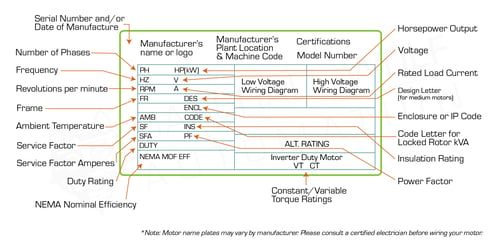
And if you're replacing an existing motor, the nameplate is your best friend. That little metal plate is packed with information that can help you identify what you have and what you need.
So, let’s break it down.
The actual rated speed you see on a nameplate will usually be a little lower than the theoretical synchronous speed. For example, a 4-pole motor may have a rated speed around 1750 RPM rather than exactly 1800 RPM.
So, why not just choose the fastest motor available? Because your application gets a vote.
A pump, conveyor, fan, compressor, or other piece of equipment may require a specific speed to operate correctly. Higher-speed motors can also be smaller and less expensive for the same horsepower, but that doesn't mean they're the right fit for every application.
When replacing a motor, matching the RPM of the existing motor is usually a good place to start.
Single-Phase or Three-Phase?
Now we get to how the motor is powered.
And if you're pairing a motor with a variable frequency drive, make sure the motor and drive are compatible with one another.
Frame Size: Will It Actually Fit?
Here's where things get physical.
A motor can have the correct horsepower, RPM, and voltage and still be completely useless if it doesn't physically fit the equipment.
You may see frame numbers such as 56, 143T, 254T, or 284T on a motor. The frame size helps define the motor's physical dimensions, including shaft height, mounting dimensions, and other critical measurements.
Think of it as the motor's shoe size. You can have the perfect pair of shoes, but they're not going anywhere if they don't fit.
If you're replacing an existing motor, matching the frame size is one of the easiest ways to help ensure the replacement physically fits.
How Does the Motor Mount?
What Kind of Environment Will It Live In?
Now we get to one of the most important questions: Where is this motor going to work?
A motor running inside a clean, dry manufacturing area has very different needs than one sitting outside in the rain, next to a dusty crusher, or getting blasted with cleaning chemicals every night.
That's where the motor's enclosure comes into play.
Does Your Application Need Something Special?
Not every motor application is a standard, everyday job.
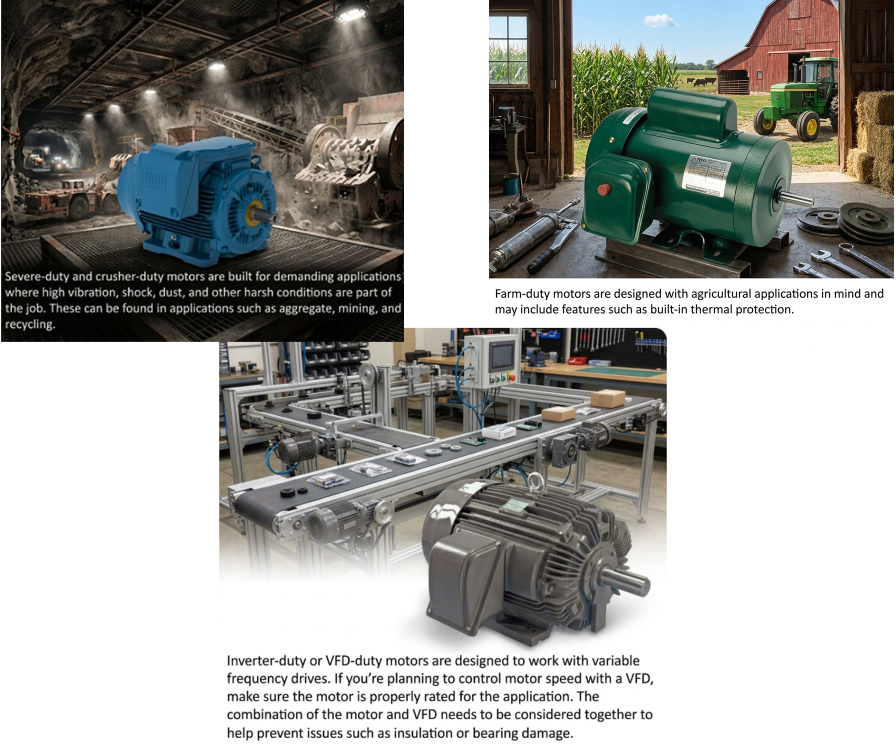
Sometimes your motor needs to deal with vibration, shock, agriculture, variable speed, or other demanding conditions. That's where special-duty motors come in.
Now that we've walked through the major motor-selection questions, let's go back to that little metal plate we mentioned earlier.
So, What Does the Nameplate Tell You?
A motor nameplate can contain a surprising amount of information. Depending on the motor, you may find:
Replacing an Existing Motor? Start With the Nameplate.
If your existing motor has reached the end of its long and hardworking career, you might want to avoid immediately guessing replacement specifications.
Take a picture of the nameplate.
Seriously. It can save you a lot of time.
If the exact model is obsolete or no longer available, that doesn't necessarily mean you're stuck redesigning your entire application.
That's where cross-referencing can help.
A Motor Doesn't Have to Be a Mystery
There are a lot of motor options out there. Once you start digging into manufacturers, frame sizes, enclosures, efficiency ratings, mounting configurations, and special-duty options, it can get chaotic pretty quickly.
But you don't have to start with every specification at once.
Start with the basics:
How much horsepower do I need?
How fast does it need to run?
What voltage and phase are available?
How does it need to mount?
What kind of environment will it operate in?
Does the application require a special-duty motor?
Once you have those answers, the giant motor catalog starts looking a lot less intimidating.
And if you're still staring at the options thinking, “Okay...but which one actually fits my application?”